EBaMl
EBaMl explains an Explainable Boosting Machine (EBM) in plain words. An EBM is a glass-box model for tabular data: it adds one learned graph for each feature, so a person can read how each feature moves a prediction. EBaMl gives the graphs and the predictions of an EBM to a large language model (LLM), and returns text that a data scientist, a customer or a regulator can read.
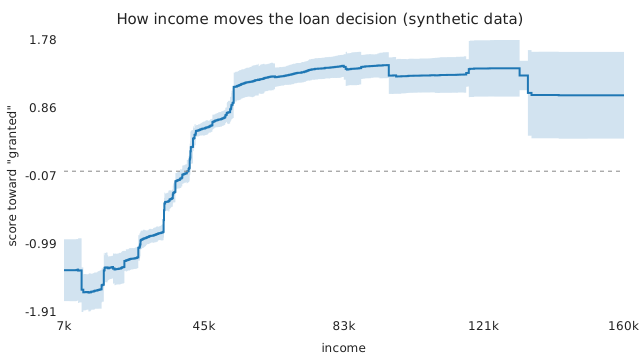
- Describe a model.
describe_graphanddescribe_ebmturn each graph, and the whole model, into a description. - Explain one prediction.
explain_instancegives a local explanation: what must change to flip the decision, which inputs settle it, and how certain it is. Python computes these facts from the scores of the EBM, and the LLM only puts them in words. - Edit a model.
EditSessionchanges the graphs to meet a requirement of the business, with a report and a history. - Give the model to an agent.
ebaml-mcpis an MCP server with tools to read, explain and edit the model. - Use any LLM. The default is the free router of OpenRouter. Pass
model=to use OpenAI, Anthropic, Gemini, a local Ollama server or another provider. The LLM gets the graph text and, for a local explanation, the values of the input. To keep the data on your machines, use a local model.
EBaMl is based on TalkToEBM. Python reads the EBM, and BAML holds the prompts and the LLM clients.
Start here
Choose the page for what you need:
-
I do not know what an EBM is
Learn what an Explainable Boosting Machine is, how it makes a prediction, and what it costs.
-
I must explain decisions to people
See one prediction go from the model to a text for a layperson, with the facts behind each sentence.
Why EBaMl?, then Local explanations
-
I know EBMs, and I want the API
Install the package, describe a graph or a model, and choose the LLM.
Setup, Usage and API reference
-
I build an agent
Give an EBM to an agent through the MCP server: tools to read, explain and edit the model.
Quick start
Install the package, and set a free OpenRouter key in your shell:
pip install ebaml
export OPENROUTER_API_KEY=sk-or-...
Fit an EBM, and ask for a description of the graph of its first feature:
from interpret.glassbox import ExplainableBoostingClassifier
from sklearn.datasets import load_breast_cancer

from ebaml import DescribeGraphRequest, describe_graph

X, y = load_breast_cancer(return_X_y=True, as_frame=True)
ebm = ExplainableBoostingClassifier(interactions=0).fit(X, y)
print(describe_graph(DescribeGraphRequest(ebm, feature_index=0)))
The free router picks a model for each request, so the text changes from run to run.
The notebooks show each feature step by step, with the output of each step.
Supported models
| Feature | Binary classifier | Regressor | Multiclass classifier | Interactions |
|---|---|---|---|---|
Graph descriptions (describe_graph) |
✅ | ✅ | ✅ | ⚠️ |
Model summary (describe_ebm) |
✅ | ✅ | ✅ | ⚠️ |
Graph text (EBMGraph) |
✅ | ✅ | ✅ | ⚠️ |
Local explanations (explain_instance) |
✅ | ✅ | ✅ | ❌ |
MCP server (ebaml-mcp) |
✅ | ✅ | ✅ | ⚠️ |
Editing (EditSession) |
✅ | ✅ | ✅ | ⚠️ |
✅ supported. ⚠️ partly supported: the main effects are described, and the interaction terms are skipped.
describe_graph and describe_ebm name them in the prompt, so the description says that it leaves them out, and they
log an interactions_skipped warning. ❌ not supported yet. Full support is on the
roadmap.
How EBaMl differs from TalkToEBM
TalkToEBM builds the prompts in Python and calls OpenAI or Azure directly. EBaMl keeps the Python that has to touch the EBM (extracting and simplifying the graphs) and moves the rest to BAML: the prompts, the LLM clients with their retries, the chain-of-thought pipelines and the token accounting. The pipelines can be tested offline on a scripted client. EBaMl also adds the local explanations, the editing of a model, the MCP server and the choice of the LLM from Python.